
New homes in converted former Melton workhouse to be available soon
The developers who have converted a historic former Melton Mowbray workhouse into new homes have revealed some of the challenges involved.
The workhouse, which is thought to date back to 1834, is located on the old St Mary’s Hospital site, on Thorpe Road, which was left vacant and derelict after the new Melton Mowbray Hospital opened in 2006.
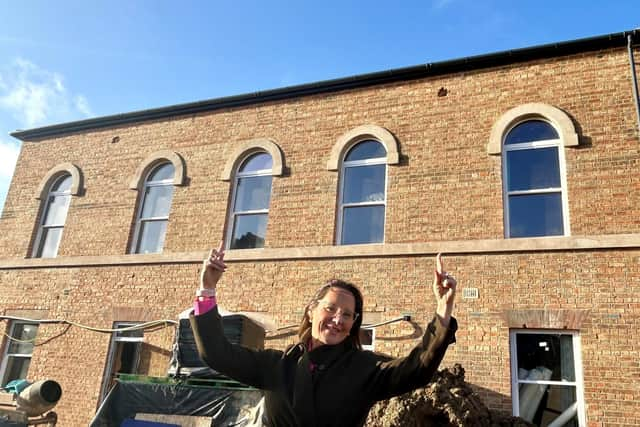

Melton Borough Council approved a planning application back in 2020 to build 37 houses and apartments on the land after councillors were satisfied it would be a sensitive transformation of the site
Campaigners won a battle for one of the 19th century vagrant cells, adjacent to the workhouse, to be retained as a heritage visitor attraction and that was unveiled earlier this year.
Perfecta Assets acquired the former workhouse, which was earmarked for eight of the properties, and the company focused on keeping some of its historic architectural features.
Simon Ash, project manager for the company, told the Melton Times: “We were delighted to acquire the building and to learn of the efforts of many to save it from demolition.
"As a developer, we seek projects that not only present the chance to create new homes, but also offer something in the way of architectural interest or conservation of historic features.
“We’re proud that we’ve achieved a combination of both at St Mary’s.
"We’ve worked hard to be sympathetic to the building’s façade, and respect its integrity whilst reimagining its interior as comfortable, characterful homes."
The architecture of the workhouse was characterised by robust brickwork, symmetrical proportions, and practical internal layouts, reflecting the utilitarian values of the period.
Preserving these original features became a guiding principle throughout the restoration.
External brick façades were carefully cleaned and repointed using traditional lime mortar. Original window openings were reinstated where possible.
Internally, many of the original structural elements were retained and celebrated, including exposed beams, high ceilings, and surviving partition walls.
And the developers say all modern services, the heating, insulation, wiring, and plumbing, were discreetly integrated so as not to intrude upon the historic character of the building.
All properties, which range from one to three bedrooms, have Positive Input Ventilation installed.
“We’ve built four houses and four apartments, featuring an array of noteworthy features, including some four-metre high ceilings, double arched windows and exposed original timber work, which I’m sure will stir up memories of its former interior,” added Simon.
“I hope the evolution of the site provides local interest, as it’s been a privilege – although at times, challenging – to be part of its recreation as a centre point of the local community.”
The branch of Newton Fallowell estate agents will be marketing the new homes with some likely to be available to view in February.
Branch manager, James Dawson, and Sales negotiator, Sara Wilson-Wright, were impressed with the build quality when they took a look at the restoration project.
Sara said: “After meeting Simon, we felt that he has perfectly captured the importance of respecting the property and its history, whilst bringing the property into the modern world.
"It certainly felt that he has brought life into the former building.”
An open day is being planned early in the new year – call Newton Fallowell for details about the properties.